Cohesive, Coordinated, Matching: The Vocabulary of Junk Journal Collections
By Ephemera Crafts Atelier
•
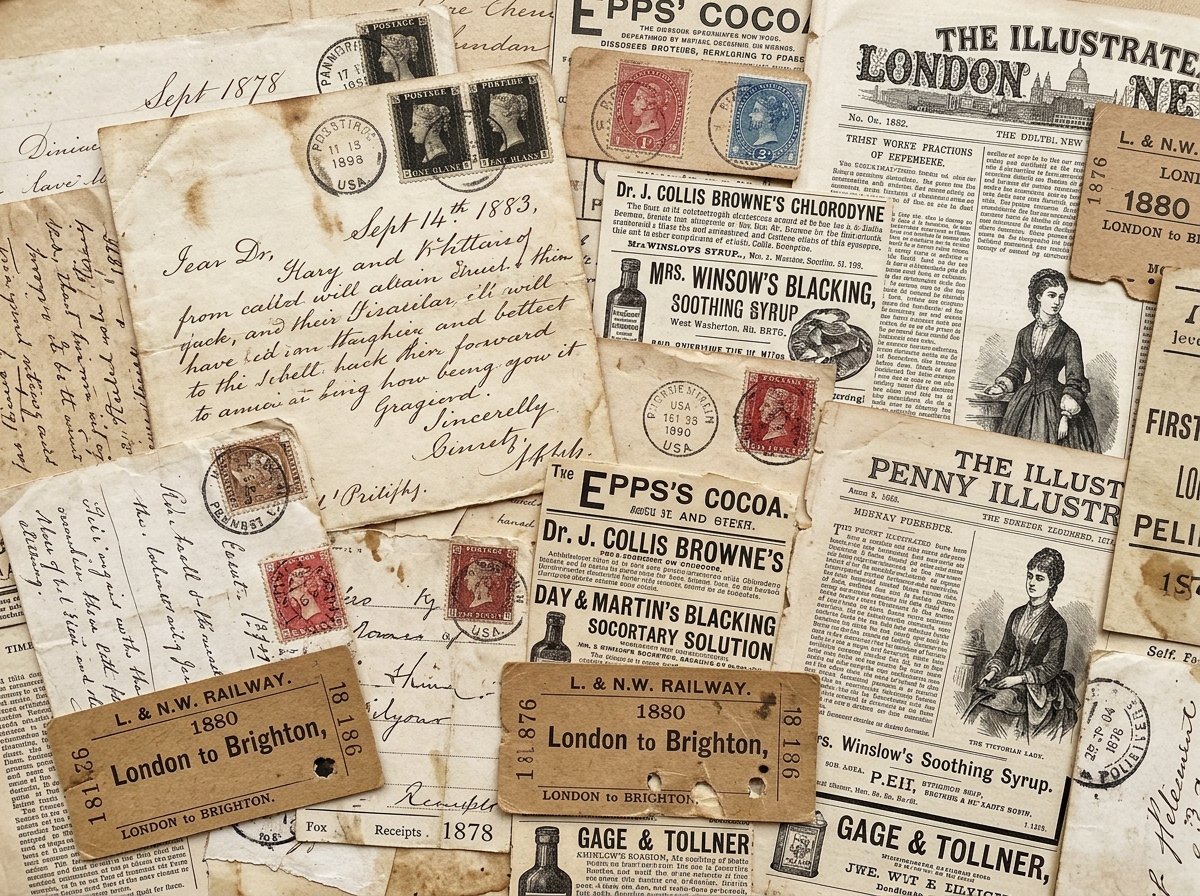
"Cohesive" is the most-used and least-understood word in the Etsy digital paper niche. Here is what it means — and the words that say it more precisely.
Spend five minutes browsing junk journal kits on Etsy and you will meet the same adjective a hundred times: **cohesive**. Sellers use it as a promise, buyers read it as a hope, and almost nobody defines it. That is a shame, because the word has a real, useful meaning — and a family of related terms that can make a listing clearer, more honest and easier to search. This guide is the vocabulary lesson we wish we had before naming our own collections.
## First, the word itself: cohesive
**Cohesive** (approximately "koh-HEE-siv") means "sticking together" — literally, from the Latin for clinging. In the Etsy digital papers and junk journal niche it describes a collection whose elements *visually belong to one another*: a shared palette, consistent textures, one era or artistic style, and a mood that does not change from item to item. A cohesive set looks like it was designed by one hand for one purpose — because it was.
What cohesion is *not*: it is not "everything is beige", and it is not "the same pattern printed twelve times". A cohesive collection can contain a ledger page, a botanical plate, a typography sheet and a plain toned paper — as long as they share a palette, a level of detail and a period feel. Variety inside rules is exactly what makes a set feel designed rather than assembled.
> **Quick example:** Eighteen pages in faded olive, cream and rust, mixing aged ledgers, muted botanical plates and worn typography: cohesive. The same eighteen pages plus three neon floral sheets: no longer cohesive — the neon breaks the palette, the era and the mood in one move.
## The terms, precisely
These are the words you will meet in listings, collection descriptions and design briefs. They overlap, but they are not interchangeable — and using the right one is a small act of professionalism that buyers notice.
| Term | What it means in the Etsy digital paper context | Where you use it |
| :--- | :--- | :--- |
| **Cohesive Collection** | A complete collection with one aesthetic: shared palette, textures and artistic style across every item. | Collection title, bundle description, shop section intro |
| **Cohesive Design** | The design quality of individual products and elements being consistent with one another — the "glue" between items. | Product descriptions, design notes, custom work |
| **Coordinating Papers** | Papers that pair by colour and pattern, even when they are sold separately. They are made to be combined, not to be identical. | Paper pack titles, bundle contents lists |
| **Matching Ephemera** | Cards, tags, pockets and other pieces that fit the main collection — the accessories of the set. | Ephemera pack listings, kit contents |
| **Coordinated Junk Journal Kit** | A complete kit of coordinated pages, backgrounds, pockets, tags and ephemera — everything needed for one journal in one style. | Kit titles, "what's included" sections |
| **Collection-Wide Visual Consistency** | The overall visual unity of all products in one collection, including items sold separately. | Collection pages, lookbooks, brand statements |
## Matching vs. coordinating vs. cohesive
These three get mixed up constantly, so here is the clean distinction:
* **Matching** means the same or nearly the same: a tag that uses the identical motif, scale and colour as the paper behind it. Matching is a relationship between two specific items.
* **Coordinating** means designed to go together without being identical: a rust-striped paper and a cream botanical page that share a palette. Coordinating is a relationship between items that are different by design.
* **Cohesive** describes the whole: when every element — matching or coordinating — creates one impression. Cohesion is the result, not the method.
A useful sentence to keep: *matching items repeat each other, coordinating items complement each other, and a cohesive collection makes both feel inevitable.*
## Related words worth knowing
A few more terms from the same family, because listings often blur them:
* **Collection** — a designed family of products sharing one visual system, released under one name;
* **Bundle** — a packaged offer that groups items for value; a bundle can combine several collections, which is exactly why "cohesive bundle" is sometimes a stretch;
* **Set** — simply items sold together, with or without a shared design language;
* **Series** — items released over time in a shared style, often numbered (Vol. I, Vol. II).
Used precisely, these words help buyers understand what they are getting: a set is convenience, a collection is a design decision, a bundle is a price decision.
## How to use the vocabulary in listings — without sounding like a keyword robot
The rule is simple: use the strongest true word, once, in a sentence that proves it. Examples that do real work:
* "A **cohesive collection** of 24 printable papers in muted autumn tones — every page shares the same palette and aged texture."
* "**Coordinating ephemera** pack: tags, pockets and labels designed to sit with the Autumn Ledger papers."
* "**Collection-wide consistency**: the same three botanical motifs repeat across papers, tags and fussy cuts at different scales."
What not to write: "cohesive cohesive collection cohesive design matching coordinating papers" — a string of adjectives with no evidence reads as keyword stuffing to buyers and to search algorithms alike. One precise claim, backed by a visible fact, outperforms five vague ones.
## Four tests before you call a set cohesive
1. **The squint test.** Step back and squint at the whole collection laid out. If it reads as one palette and one mood, you are close.
2. **The thumbnail test.** Shrink all items into a grid of small previews, the way buyers see them in search results. Items that only "work" at full size are not cohesive at thumbnail scale.
3. **The era test.** Do the fonts, illustrations and textures belong to the same period or style family? A Victorian botanical next to a 1980s geometric pattern needs a very deliberate reason.
4. **The swap test.** Drop in one item from a different collection. If it disappears into the set, your visual system is strong; if it shouts, the set was never as unified as it felt.
## Why this matters beyond vocabulary
Buyers of digital kits are not just buying paper — they are buying a decision already made. A journaler who struggles to combine patterns will pay for a set that combines itself. That is the real value of cohesion, and the reason the word sells: it promises less work and a better result. Sellers who use it honestly build repeat customers; sellers who use it as decoration train buyers to distrust the label.
Once the vocabulary is clear, the next steps are practical: writing titles that use these words well, and building a collection that earns them. We cover both in the companion guides below.
---
*Continue the series: <a href="/blog/etsy-listing-titles-junk-journal/">how to write Etsy titles for junk journal listings</a> · <a href="/blog/build-cohesive-junk-journal-kit/">how to build a cohesive kit from mood board to listing</a> · <a href="/blog/etsy-glossary-digital-paper/">Etsy glossary for digital paper sellers</a>.*