How to Date an Old Photograph: Mounts, Paper and Studio Marks
By Ephemera Crafts Atelier
•
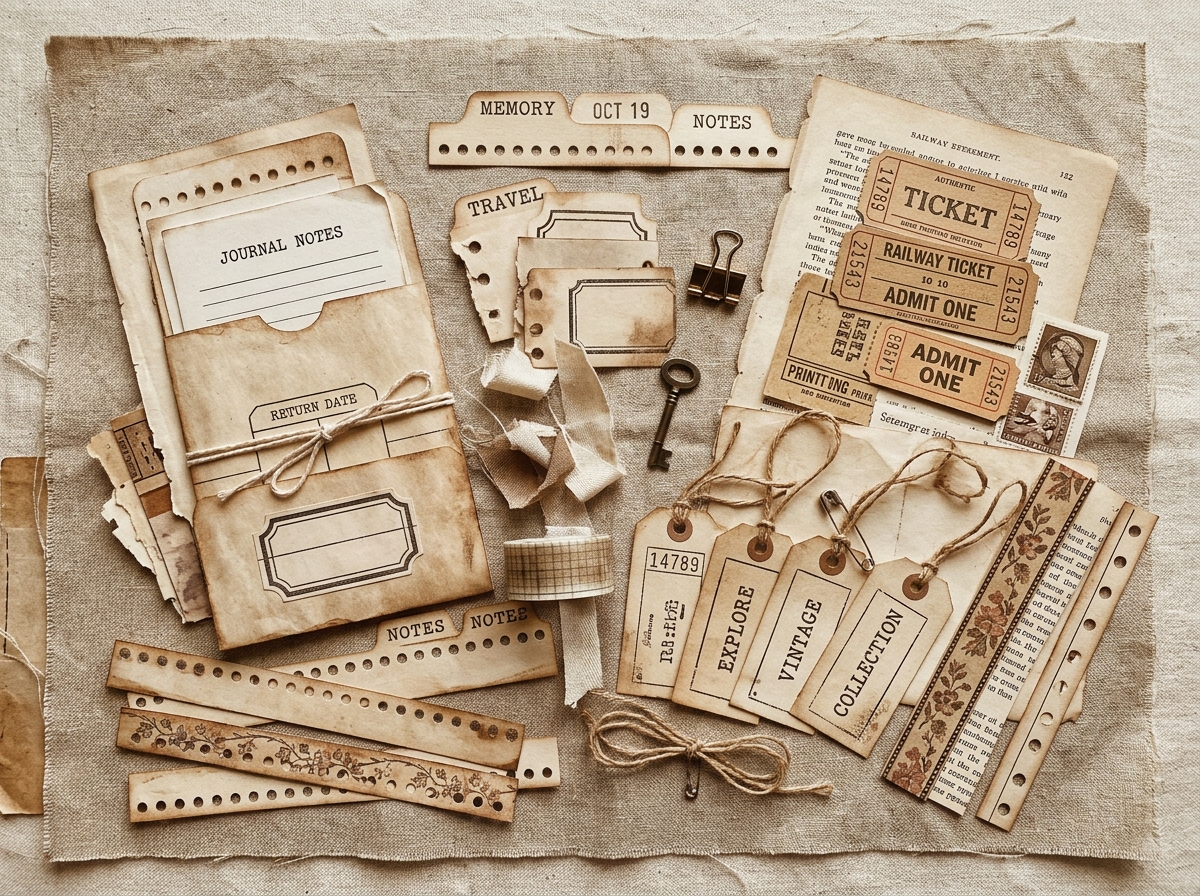
Most old photographs can be placed within a few decades without any specialist equipment — if you know where to look.
An undated photograph is a frustrating object: a face, a room, a moment, with no anchor in time. The good news is that photographs carry their own dating evidence — not in the image alone, but in the object around it: the mount, the paper, the studio imprint, the way it was printed and finished. This guide walks through six clues in the order that usually gives the most information.
## 1. Identify the format first
The physical shape of the photograph narrows the possibilities immediately. These are general ranges, not rules — studios used old stock, and local practice varied:
* **Loose, unmounted prints** — from the late nineteenth century onwards, increasingly common in the twentieth;
* **Small mounted portraits** (carte-de-visite style) — roughly the 1860s to the 1900s, sold in albums and exchanged like calling cards;
* **Larger mounted portraits** (cabinet-card style) — roughly the 1870s to the 1900s, often with elaborate studio imprints;
* **Postcard-format photographs** — early twentieth century onwards, especially "real photo" cards with a divided back;
* **Consumer snapshots** — twentieth century, smaller formats, often with deckled or scalloped edges;
* **Instant photographs** — mid-to-late twentieth century, with characteristic white borders and chemical sheen.
## 2. Read the mount and the studio imprint
The mount is often the single most informative element. Look for:
* **Photographer's name and address** — the strongest clue. A studio address can be checked against old directories and local history collections;
* **Embossed or printed borders** — decorative frames, gilt edges, blind stamping; their style changes with fashion;
* **Back advertisements** — many mounts carry studio adverts listing services, medals or branch addresses; these are gold for dating;
* **Card thickness and colour** — thin white card, cream board, dark brown or grey mounts each suggest different periods;
* **Text style** — typefaces, monograms and layout follow commercial design trends.
If the mount has been trimmed or the imprint is missing, move to the next clues — but do not discard the mount as "just packaging". It is part of the object.
## 3. Examine the print itself
Photographic processes leave visible signatures. Albumen prints of the nineteenth century often have a warm, slightly yellowish tone and a thin, glossy surface; gelatin silver prints of the twentieth century tend to be cooler and more neutral. Real photo postcards usually have a distinctive postcard back, sometimes with the photographer's name or a stamp box. Instant prints have their own borders and surface.
Also note the edges: deckled or scalloped edges, white borders, and the presence of a printed caption all help place a photograph in a broad era. None of these is decisive alone — they are cumulative.
## 4. Use fashion and props carefully
Clothing is the most tempting clue and the most misleading. Hairstyles, collars, sleeve shapes and hats can suggest a decade, but fashions lag, studio props are reused, and older relatives often wore outdated styles. Use fashion as a supporting clue, not a verdict:
* compare several garments, not one detail;
* check children as well as adults — children's clothing often dates more precisely;
* treat uniforms and occupational dress as strong but specialised evidence;
* remember that studio backdrops and props may be older than the sitter's clothes.
## 5. Read inscriptions and stamps
Handwriting, ink colour and inscriptions can narrow a date: a name, a place, "aged 21", a holiday greeting. Stamps and postmarks on postcard photographs are precise evidence, though the card may have been printed earlier than it was sent. Pencil notes are easily added later; treat them as hints rather than facts.
## 6. Cross-check and record uncertainty
The professional habit is to combine at least three independent clues before assigning a decade. If the mount says 1880s, the clothing says 1890s and the inscription says "Aunt May, 1901", you have a story — perhaps a reprint, perhaps a later inscription. Record what you know and what you infer separately.
| Clue | What it can suggest | Caution |
| :--- | :--- | :--- |
| Format and mount | Broad era and market | Old stock used later; mounts trimmed |
| Studio imprint | Place and active years | Studios changed names and addresses |
| Print process | Late 19th vs 20th century | Reprints and copies confuse |
| Fashion | Decade tendencies | Lags, props, local variation |
| Inscription / postmark | Specific date | Added later; card sent after printing |
> **Handle with care:** Hold photographs by the edges; oils from fingers damage emulsion. Scan at high resolution before framing or using in a journal, and store originals in acid-free sleeves away from light. Never write on the front of a photograph.
## Why dating matters for journal makers
A dated photograph changes how it reads on a page. A portrait from the 1880s belongs with different paper, typography and colour than a 1950s snapshot; knowing the decade helps you build a spread that feels coherent rather than costumed. It also protects you as a collector: a photograph described as "Victorian" but actually mid-twentieth-century is a small piece of misinformation that spreads.
Start with the mount, confirm with the print, support with fashion, and write down your reasoning. Even an approximate date — "likely 1890s–1900s" — is far more useful than none, and the process itself turns an anonymous object into a document.
---
*More paper literacy: <a href="/blog/evolution-of-the-postcard/">the evolution of the postcard</a> · <a href="/blog/victorian-calling-cards-ephemera/">Victorian calling cards</a> · <a href="/blog/paper-science-sizing-acidity/">how paper ages</a>.*