The Ethics of Cutting Up Old Books
By Ephemera Crafts Atelier
•
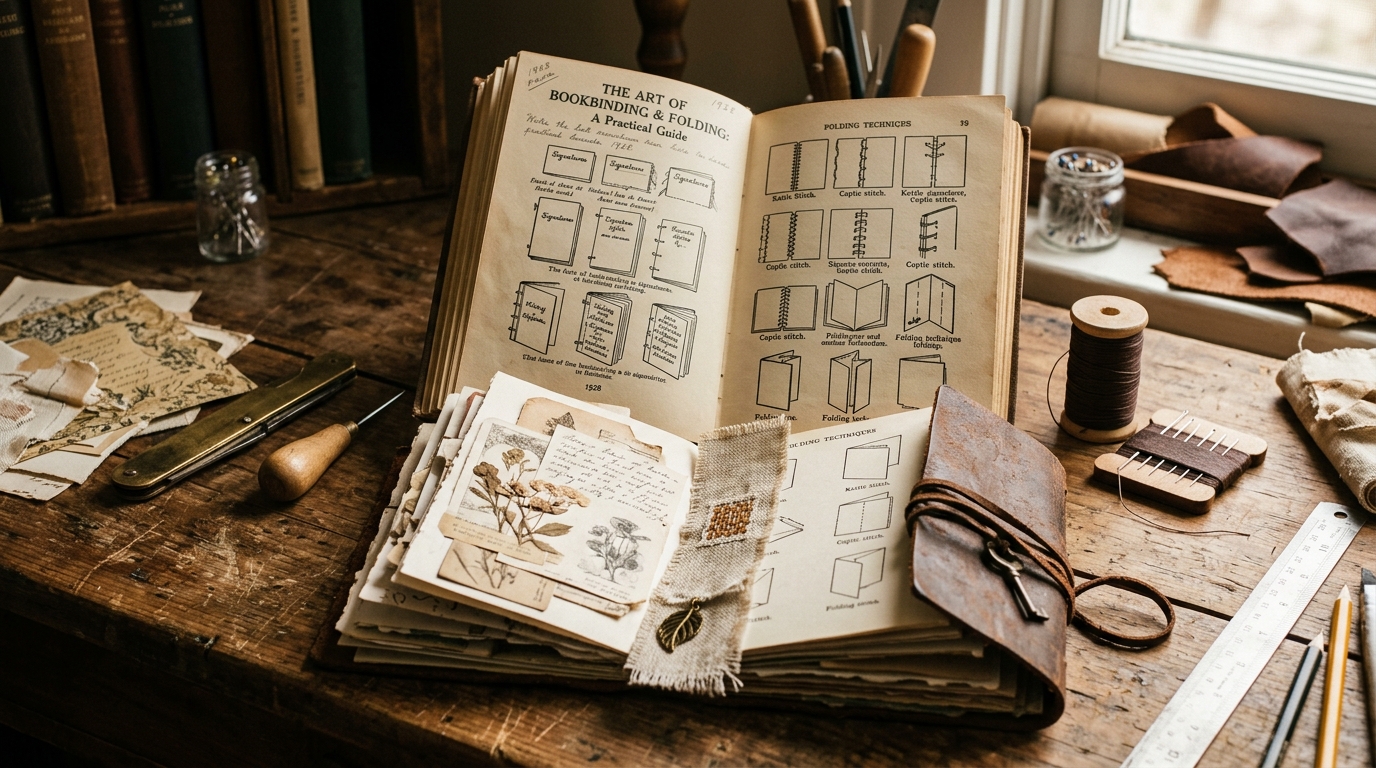
Junk journaling runs on rescued paper. But every cut page raises a question the craft rarely asks out loud.
There is a moment in every junk journaler's life when the knife hovers over an old book and something hesitates. The book is already damaged, or cheap, or common — and yet it is a book. Cutting it feels like both rescue and vandalism at once. This essay is an attempt to think that through honestly, without either romanticising destruction or pretending that every worn volume is a museum piece.
## The case for cutting
Most books that end up in craft rooms are not rare. They are mass-produced, incomplete, water-damaged, foxed, or simply unwanted. Their commercial value is near zero; their cultural value may be modest; their pages, however, are beautiful and useful. Using them keeps paper in circulation instead of in a landfill, and it gives an ordinary object a second life in someone's journal.
There is also a preservation argument. A book that is falling apart may be better served by having its pages used, photographed and shared than by sitting in a box until it crumbles. Many journalers scan pages before cutting, creating a digital copy that outlasts the physical book. In that sense, responsible cutting can be a form of documentation.
## The case for caution
Books are not only text. They are objects with bindings, annotations, provenance, marginalia, inserts — evidence of how they were made, sold, owned and read. Breaking a complete copy destroys that evidence permanently. A first edition, a signed copy, a book with family inscriptions, a scarce provincial printing: these are not craft supplies, however attractive their pages.
There is also a market effect. As junk journaling grows, demand for "old book pages" can push up prices and encourage sellers to break books that would otherwise be preserved. The ethical question is not only "what am I doing with this book?" but "what is my demand teaching the market?"
## A practical triage
The following questions are not a law, but a habit. Ask them before the knife:
1. **Is the book complete and intact?** If yes, pause. A complete copy can be read, studied, digitised or donated; a cut one cannot be un-cut;
2. **Is it scarce, signed, annotated or valuable?** If yes, do not cut. Scan, photograph, or use a different copy;
3. **Is it already damaged?** Broken spines, missing pages, water damage and heavy foxing make a book a legitimate candidate for reuse;
4. **Is there a digital copy?** If the text is widely available online, cutting a physical copy is less loss — but still a choice;
5. **Will the pages actually be used?** Cutting a book to store its pages in a drawer is not rescue; it is a slower discard.
> **The scan-first rule:** Whatever you decide, scan the pages you plan to use. A good scan preserves the design, the typography and the texture, and lets you print replacements at any size. It also means the physical book does not have to be cut at all if you only need the look.
## What archives actually do
Libraries and archives routinely remove materials from their collections — through deaccessioning policies, sales, donations or, in some cases, disposal. The professional norm is not "keep everything forever"; it is "make a deliberate, documented decision with clear criteria". Crafters can borrow that mindset without pretending to be institutions: decide deliberately, record what you have, and prefer reversible actions when in doubt.
## Towards a working ethic
* **Prefer damaged and incomplete copies** for cutting;
* **Never cut unique documents** — letters, diaries, ledgers with provenance, annotated books;
* **Scan before cutting**, and keep the files organised;
* **Document provenance** when you know it; a page with a story is worth more than anonymous paper;
* **Donate intact books** you do not need rather than breaking them for a few pages;
* **Be honest as a seller:** describe sources, do not glorify destruction, and price the work fairly.
None of this makes the craft unethical. It makes it thoughtful. The difference between a vandal and a conservator is not the knife — it is the decision made before the knife comes out.
---
*Related: <a href="/blog/what-is-ephemera/">what ephemera is</a> · <a href="/blog/how-to-scan-and-reduce-size-colored-pages-old-books/">scanning old book pages</a> · <a href="/blog/paper-time-capsule/">the paper time capsule</a>.*