Junk Journal vs. Scrapbook vs. Glue Book: What's the Difference?
By Ephemera Crafts Atelier
•
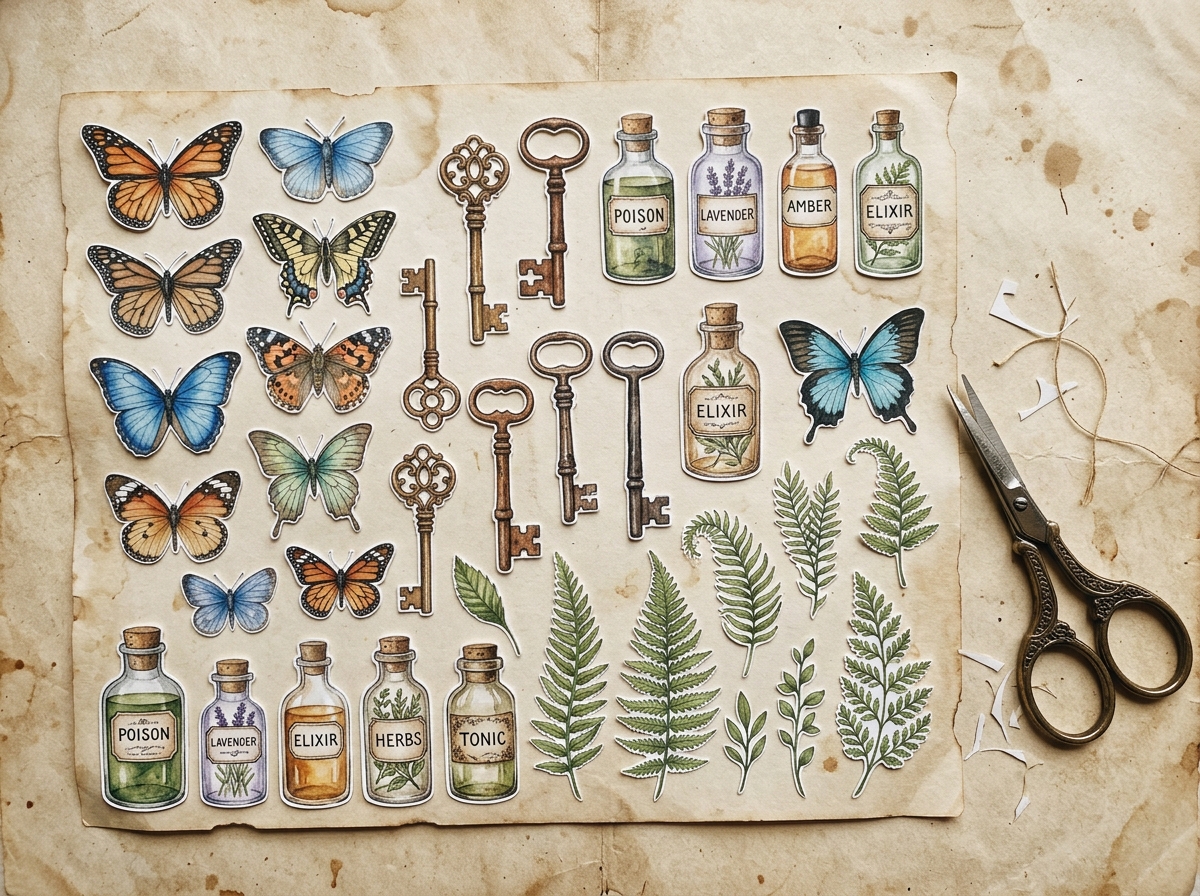
Four paper-keeping traditions, four sets of rules — and how to choose your first one. Exploring the differences between junk journals, scrapbooks, glue books, and commonplace books.
Newcomers meet the same confusion: is a junk journal just a messy scrapbook? Is a glue book a journal without words? Is a commonplace book something from a period drama? The short answer is that all four are forms of paper memory-keeping, but they follow different rules about materials, structure and purpose. Once you see the rules, choosing your first format becomes easy.
## The quick comparison
| Format | Materials | Structure | Purpose | Attitude |
| :--- | :--- | :--- | :--- | :--- |
| **Junk journal** | Rescued, recycled and printed paper | Handmade book with pockets, flaps, signatures | Recording life and making something beautiful from what would be thrown away | Imperfection is the aesthetic |
| **Scrapbook** | Photo-safe, purpose-bought supplies | Album pages, often plastic-protected | Preserving photographs and milestones archivally | Neatness and longevity |
| **Glue book** | Scraps, tickets, cuttings, packaging | Any bound book filled by pasting | The pleasure of arrangement; visual flow | Play, no rules |
| **Commonplace book** | Mostly writing; paper is secondary | Notebook, often indexed by topic | Collecting quotes, ideas and knowledge | Text first, decoration optional |
Now the nuances, because the table hides the interesting parts.
## Junk journal: the handmade book of rescued paper
A junk journal is usually a *book you build*: folded signatures sewn or clipped together, pages made from old book paper, envelopes, printables and tea-stained sheets, with pockets, tuck spots and belly bands holding loose treasures. The defining feature is not "junk" as in ugly — it is junk as in rescued. Receipts, maps, letters, wallpaper scraps: things that were never meant to last become the material. Writing happens in the gaps, which is why junk journals feel like diaries that grew a collage habit. If you are starting from zero, our [Beginner's Guide](/blog/how-to-start-junk-journaling/) covers the whole first build.
## Scrapbook: the archive with a design brief
Scrapbooking grew out of the impulse to preserve photographs and family milestones with archival materials: acid-free paper, photo corners, page protectors, captions with names and dates. It is closer to curating an exhibition than to making a messy book — layouts are planned, products are coordinated, and longevity is a design requirement. Junk journaling borrows scrapbooking's layering skills but deliberately relaxes its archival rules. Neither is "better"; they answer different questions. Scrapbooking asks "how do I keep this safely for fifty years?"; junk journaling asks "how do I make this feel alive now?"
## Glue book: collage without commentary
A glue book is the purest form: a bound book (often an old ledger or exercise book) where you paste paper scraps — tickets, stamps, labels, cuttings — in loose compositions, with little or no writing. There is no plot and no chronology; the pleasure is arrangement, colour and texture. Many junk journalers keep a glue book as a "palette cleanser" between bigger projects, or as a place to test layouts before committing them to a journal page. If you enjoy collage but freeze at the thought of journaling prompts, start here.
## Commonplace book: the ancestor with a pen
The oldest of the four, the commonplace book is a notebook for collecting passages, quotes, recipes, ideas and observations, usually organised by theme. It has been kept since the Renaissance as a thinking tool — a place to copy what matters and add your own notes. Its modern descendants are everywhere: reading journals, quote books, "book of shadows", even well-kept Notion databases. Paper ephemera enters only as decoration or as markers. If your instinct is to write rather than paste, this is your format — and it pairs beautifully with a junk journal: one for thinking, one for making.
## What about smash books and travellers notebooks?
Two useful neighbours: a **smash book** is a commercial album with pre-decorated pages meant to be filled quickly and messily — junk journaling's relaxed cousin; a **travellers notebook** is a leather or fabric cover holding interchangeable inserts, ideal for on-the-go journaling. Both are formats, not philosophies: you can keep a junk journal inside a travellers notebook cover, or use smash-book pages as signatures in a handmade book. The labels blur, and that is fine.
> **How to choose:** Ask what you want to do tomorrow: *write* → commonplace book; *preserve photos properly* → scrapbook; *play with paper* → glue book; *make a book and fill it with everything* → junk journal.
## Can you mix them?
Absolutely — most working journalers do. A junk journal can hold properly archived photos in photo corners; a scrapbook can include printable ephemera; a commonplace book can have a pocket for a pressed flower. The traditions are toolkits, not borders. What matters is that you know which rules you are following on a given page, so the result feels intentional rather than accidental.
If you want one sentence to take away: **scrapbooking preserves, commonplace books think, glue books arrange, and junk journals make a book out of the paper life leaves behind.** Start with whichever sentence sounds like your weekend — the others will still be there when you are ready.
---
*Curious how far back this goes? Read [What Ephemera Is](/blog/what-is-ephemera/) — the tradition is older than any of these labels.*