Junk Journaling as an Anti-Algorithm Practice
By Ephemera Crafts Atelier
•
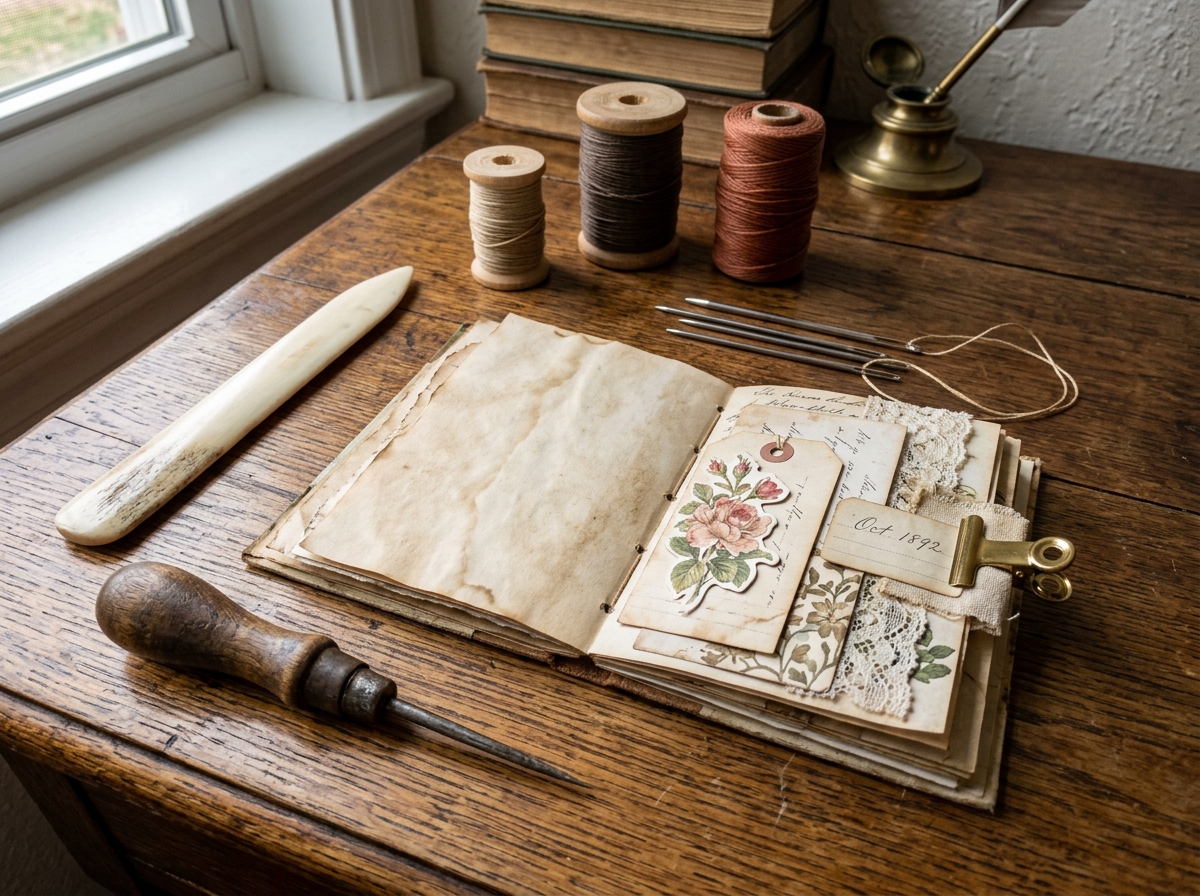
A journal has no feed, no likes and no audience. That is not a limitation — it is the point.
Almost everything we make online is shaped by an audience. We choose the thumbnail, the caption, the timing; we check how it performed; we adjust. Even hobbies are pulled into this logic — the perfect flip-through, the satisfying process video, the before-and-after. Junk journaling offers something increasingly rare: a form of making that does not need to be seen to be complete.
## The algorithmic mindset
An algorithm rewards attention, consistency and comparison. It teaches makers to think in metrics: views, saves, followers, engagement. None of these are evil in themselves — sharing work can be generous and motivating. But when the metric becomes the reason for making, the practice changes. Pages get designed for the camera rather than the hand; journals get filled with what photographs well rather than what matters; the imperfect, private, exploratory part of the craft gets squeezed out.
## What paper offers instead
* **No audience by default.** A journal is complete when you close it;
* **Process over performance.** The value is in the making, not the posting;
* **Imperfection as a feature.** Torn edges, crooked pockets and mistakes are part of the object;
* **Time as material.** Pages accumulate slowly; the journal records duration, not velocity;
* **Privacy.** Some things are worth keeping without sharing.
This is not nostalgia for a pre-digital world. The same phone that hosts the feed also holds the scans, the references and the shop. The point is not to reject technology but to protect a space where it is not the organising principle.
## Not anti-sharing — anti-compulsion
Sharing a journal can be a joy: it connects makers, spreads techniques and builds community. The problem is not posting; it is posting by default. A useful distinction: **make the page for yourself first, then decide whether it is worth sharing**. If the answer is no, the page still counts. If the answer is yes, share it as a gift rather than a performance.
## Five rules for a private practice
1. **Keep one journal that never goes online.** No photographs, no posts, no exceptions;
2. **Make pages you would not photograph.** Ugly, experimental, private — they keep the muscle flexible;
3. **Don't measure.** No page counts, streaks or targets; the journal is not a productivity system;
4. **Protect analog time.** Twenty minutes with paper and no screen, a few times a week;
5. **Let some things stay unfinished.** A journal is a place for drafts, not a portfolio.
> **The test:** Before posting a page, ask: "Would I still make this if no one saw it?" If yes, the practice is healthy. If no, the algorithm has moved into the studio.
## Why this matters for the craft
Junk journaling grew partly as a reaction to polished scrapbooking: it made room for rescued paper, imperfection and personal meaning. That spirit is easy to lose when the craft becomes content. Keeping a private practice protects the values that attracted people in the first place — resourcefulness, intimacy, patience, the pleasure of handling paper.
It also makes the shared work better. Makers who spend time away from the feed develop a personal visual language instead of copying what performs. The pages that stand out online are usually the ones that were made for someone — often for the maker themselves.
So make a page this week that nobody will see. Use the scrap you have been saving, write the thing you would not post, leave the crooked edge. That page is not content. It is the reason the rest of it exists.
---
*Related: <a href="/blog/texture-therapy-tactile-paper/">texture therapy</a> · <a href="/blog/paper-time-capsule/">the paper time capsule</a> · <a href="/blog/when-you-hate-a-page/">when you hate a page</a>.*