Junk Journaling Supplies: The Complete Guide from Starter Kit to Studio
By Ephemera Crafts Atelier
•
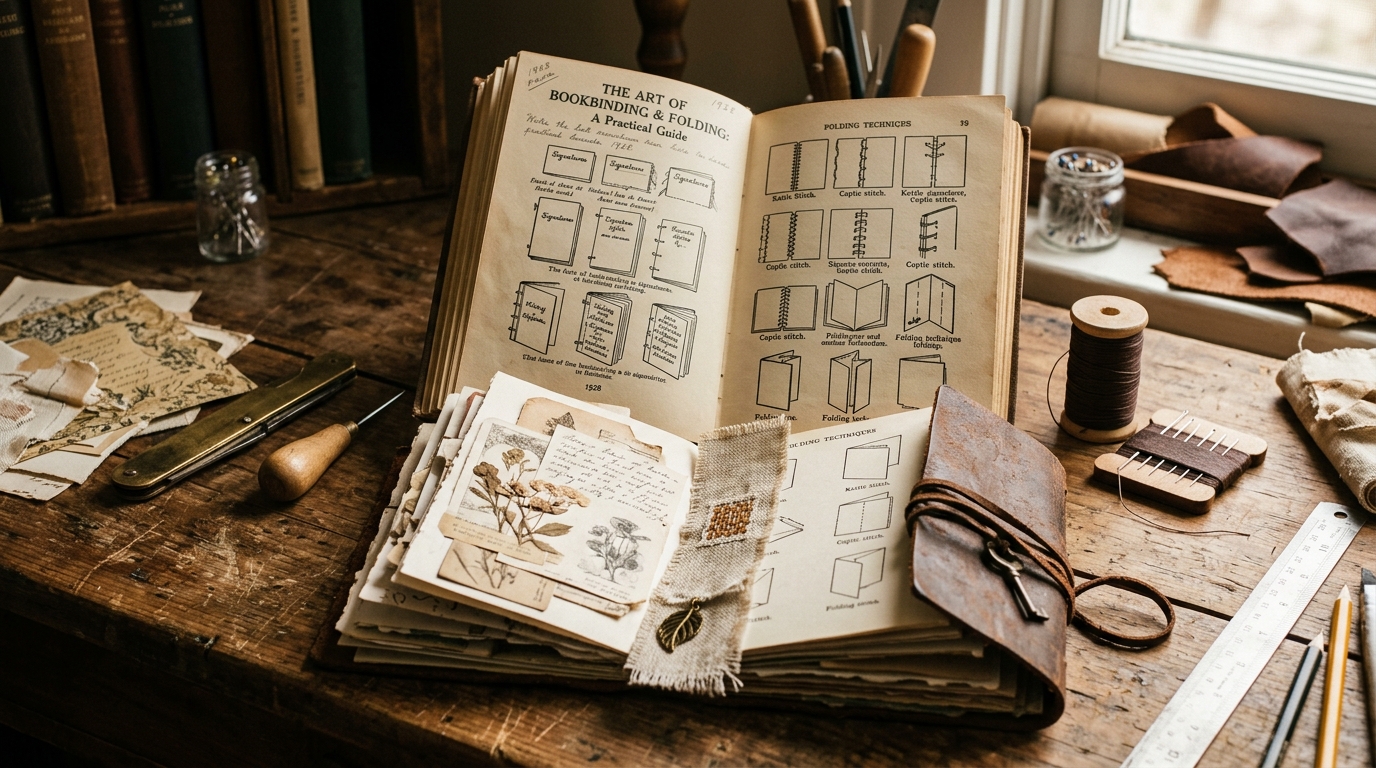
Buy less, make more: the three layers of supplies that actually matter — and the pretty things you can safely skip until later. From starter kit to full studio.
Ask ten junk journalers what you "need" and you will get ten long lists. Ask them what they actually use every single session and the lists collapse into something reassuringly small. Supplies are not the hobby — they are the tools of the hobby. This guide sorts everything into three honest layers: the core kit you need on day one, the comforts worth adding next, and the upgrades that wait until your skills ask for them.
## Layer 1 — The core kit (everything you truly need)
You can make a complete journal with this list, and nothing on it is expensive:
* **Something to journal in.** A blank notebook, or folded sheets you bind yourself. Start cheap — your first journal is a rehearsal, not an heirloom.
* **Paper and ephemera.** Recycled envelopes, receipts, old book pages, plus printable papers for the pretty parts. The digital route is the most flexible supply cupboard you will ever own — see the [Free Printables Vault](/free-printables/).
* **Two adhesives.** A glue stick for large, thin paper areas; a small bottle of PVA for pockets, cardstock and anything structural. Add double-sided tape for invisible, wrinkle-free seams.
* **Scissors and a craft knife.** Small sharp scissors for fussy cutting; a knife and metal ruler for clean pocket edges.
* **A ruler, a pencil and a pen.** Boring, indispensable. A pencil line is the difference between a straight fold and a "charming" lean.
That is a real, working kit. Everything else below is an accelerator, not a prerequisite.
## Layer 2 — Paper and printing supplies
If you print your ephemera — and in this hobby, most of us do — paper is the single most important supply after your printer itself. Two stocks cover nearly every job:
| Stock | Use it for | What to look for |
| :--- | :--- | :--- |
| Matte text paper, 28–32 lb (approx. 105–120 gsm) | Journal pages, signature spreads, printable backgrounds | Matte finish, medium weight, folds without cracking |
| Matte cardstock, 65–80 lb (176–216 gsm) | Pockets, tags, covers, envelopes | Holds a crease, not too thick for your printer feed |
Add a sheet or two of translucent vellum for overlays, and you have a complete paper wardrobe. Exact printer settings, drying habits and double-sided tricks live in our [300 DPI Printing Guide](/blog/guide-printing-300-dpi-junk-journal-printables-at-home/) — worth reading before your first print run, because bad settings waste more paper than any other mistake.
## Layer 3 — Binding tools (for handmade books)
If you want to sew your own journals rather than decorate ready-made notebooks, you need surprisingly few extra tools:
* **An awl** for piercing holes — a thick needle pushed into a cork works in a pinch;
* **Waxed linen thread and a needle** — waxed thread tangles less and holds knots;
* **Binder clips** to keep signatures aligned while you sew;
* **A cutting mat and bone folder** for clean cuts and crisp folds.
That is the whole bookbinding corner. Our [Mini Journal Tutorial](/blog/mini-junk-journal-from-one-printable-kit/) and the [Multi-Signature Guide](/blog/how-to-build-multi-signature-junk-journal-from-digital-bundles/) walk through using them step by step.
## The upgrades worth adding next
Once your first journal exists, these extend what you can do without bloating your desk:
* **Distress ink pad + blending tool** (walnut stain or vintage photo): the fastest way to make edges look a hundred years old;
* **Washi tape** in two or three muted patterns: hinge reinforcement, quick borders, page tabs;
* **A score board** if you make many pockets and envelopes — folds become repeatable;
* **A corner rounder and a small hole punch** for tags and flip pages;
* **A wax seal kit** for closures and gift journals — beautiful, but firmly optional;
* **Stamps and archival ink** for dates, labels and small motifs.
> **Studio rule of thumb:** Buy a new supply only when a project has already asked for it twice. The drawer of unused gadgets is the most expensive thing in any craft room.
## Storage that keeps paper usable
Paper is only a supply if you can find it. Keep flat storage: a shallow drawer or archival box for full sheets, vertical folders by category (backgrounds, pockets, tags, fussy cuts), and a small "current project" tray where pieces live while a journal is being built. Our [Fussy Cut Storage Folder](/product/alice-in-wonderland-fussy-cuts-storage-folder-ephemera/) exists precisely because loose small pieces otherwise migrate into every corner of the house. Keep prints away from direct sunlight; dye inks fade, and a faded print is a wasted supply.
## What not to buy at the beginning
* **Glossy photo paper.** It refuses ink edges, reflects light and makes ephemera look like stickers.
* **Giant mixed bundles.** Volume feels like value until you realise you only use ten percent of it.
* **An expensive journal before your first finished one.** Skills first; fancy covers later.
* **Every colour of everything.** A muted palette of five supplies will out-make a rainbow of fifty.
## Printable kits as a supply strategy
Here is the quiet advantage of digital supplies: a kit is not consumed. Print the pages you need, reprint a favourite background for the next journal, resize a tag, or print a single page for a card. Compared with buying physical collections, printables keep your storage flat, your palette consistent, and your spending tied to actual projects. Start with a coordinated [Kit](/category/kits/), add a [Bundle](/category/bundles/) when you want range, and keep the [Free Vault](/free-printables/) for practice prints. If you also buy physical supplies, our [Supply Shelf](/supplies/) lists what we genuinely use in the studio.
Build the core kit this week. Add one comfort next month. Let the upgrades arrive as rewards for finished journals — that is the supply list that actually produces books.
---
*Ready to stock your paper drawer? Browse the [Studio Shop](/shop/) or start free with the [Printables Vault](/free-printables/).*