Nine Reusable Spread Layouts for Junk Journals (With Diagrams)
By Ephemera Crafts Atelier
•
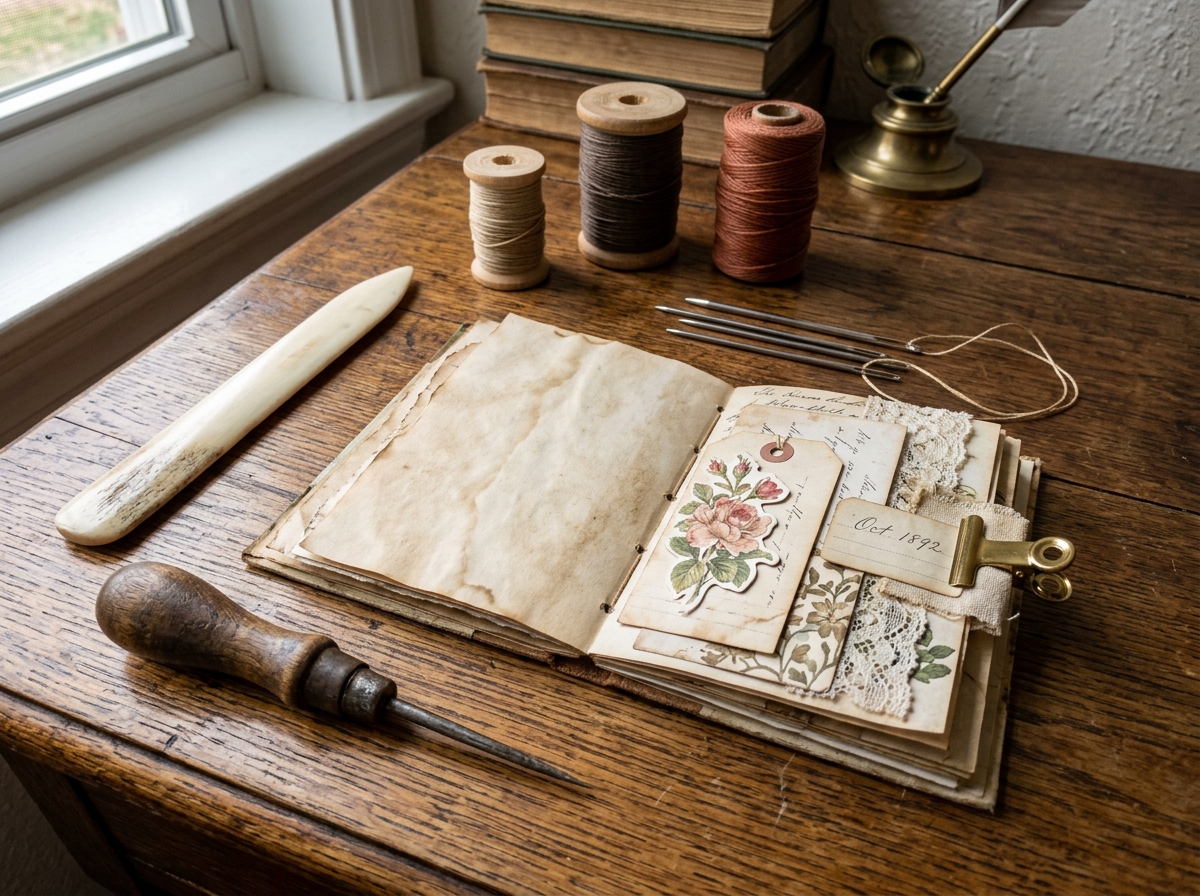
Recipes, not rules: nine compositions that remove the blank-page problem and still leave room for your hand.
Layouts are the grammar of a journal. Once you know a few reliable structures, you stop staring at an empty page and start making decisions — where the eye should land, what should be touched, where the writing goes. These nine layouts are the ones we return to most. Each works at mini and A5 scale, and each can be adapted to any palette.
### 1 · The Classic Stack
Age the whole page, place a photo or large label in the upper third, then build a small cluster at the lower left. Leave the bottom strip for writing. The most forgiving layout in the craft.
*Best for: single-photo pages, portraits, ticket-and-tag spreads.*
### 2 · The Pocket Page
A large pocket across the lower half, a tag or card emerging from it, and a calm background above. The pocket does the visual work; keep the rest quiet.
*Best for: travel pages, ticket storage, gift journals.*
### 3 · The Belly Band
A horizontal band wraps the page (or signature), holding a tag or bookmark. It adds structure without glueing anything down permanently.
*Best for: signatures, gifts, pages that need a "closure" feel.*
### 4 · The Window
Cut a clean aperture in a decorative page and mount an image behind it. The reveal creates depth and a reason to look twice.
*Best for: portraits, postcards, "hidden" pages, interactive reveals.*
### 5 · The Tag Trio
Three overlapping tags at slightly different angles create rhythm and give you three small writing surfaces. Vary height, not just colour.
*Best for: lists, dates, three-part stories, colour palettes.*
### 6 · The Tip-In Door
A piece attached along one edge only, so it opens like a door. Put writing or a small image underneath — it is the simplest way to make a page interactive.
*Best for: hidden notes, before/after reveals, secret pockets.*
### 7 · The Grid of Nine
Nine equal small elements — labels, stamps, fussy cuts — arranged in a grid. Order replaces composition; the page reads as a collection.
*Best for: stamp pages, motif studies, colour swatches, small ephemera.*
### 8 · The Diagonal Drift
Three elements step diagonally down the page, each slightly rotated. It creates movement without chaos — and leaves triangular pockets of white space.
*Best for: sequential stories, three photos, progress pages.*
### 9 · The Quiet Page
Mostly writing, one small anchor at the top and one accent at the bottom. The layout most journals lack — and the one readers actually use.
*Best for: daily entries, letters to yourself, reflective pages.*
> **How to adapt any layout:** Keep the skeleton, change the clothes: swap a photo for a tag, a pocket for an envelope, a cluster for a single label. The structure is what makes the page legible; the materials are what make it yours.
## Choosing a layout for the day
Ask three questions: **Is there a hero object?** (use Stack or Window.) **Is there something to store?** (Pocket or Belly Band.) **Is there mostly writing?** (Quiet Page.) If you have three small things instead of one big one, use Tag Trio or Grid. If the story unfolds in sequence, use Diagonal Drift or Tip-In.
Try one layout per week for nine weeks. By the end you will have a personal vocabulary — and a stack of pages that look intentional rather than accidental.
---
*Related: <a href="/blog/creative-ways-to-use-printable-ephemera/">12 ways to use printable ephemera</a> · <a href="/blog/junk-journal-engineering/">the engineering approach</a> · <a href="/blog/what-to-do-when-you-hate-a-page/">what to do when you hate a page</a>.*