Reading a Postcard: Stamps, Postmarks and Handwriting Clues
By Ephemera Crafts Atelier
•
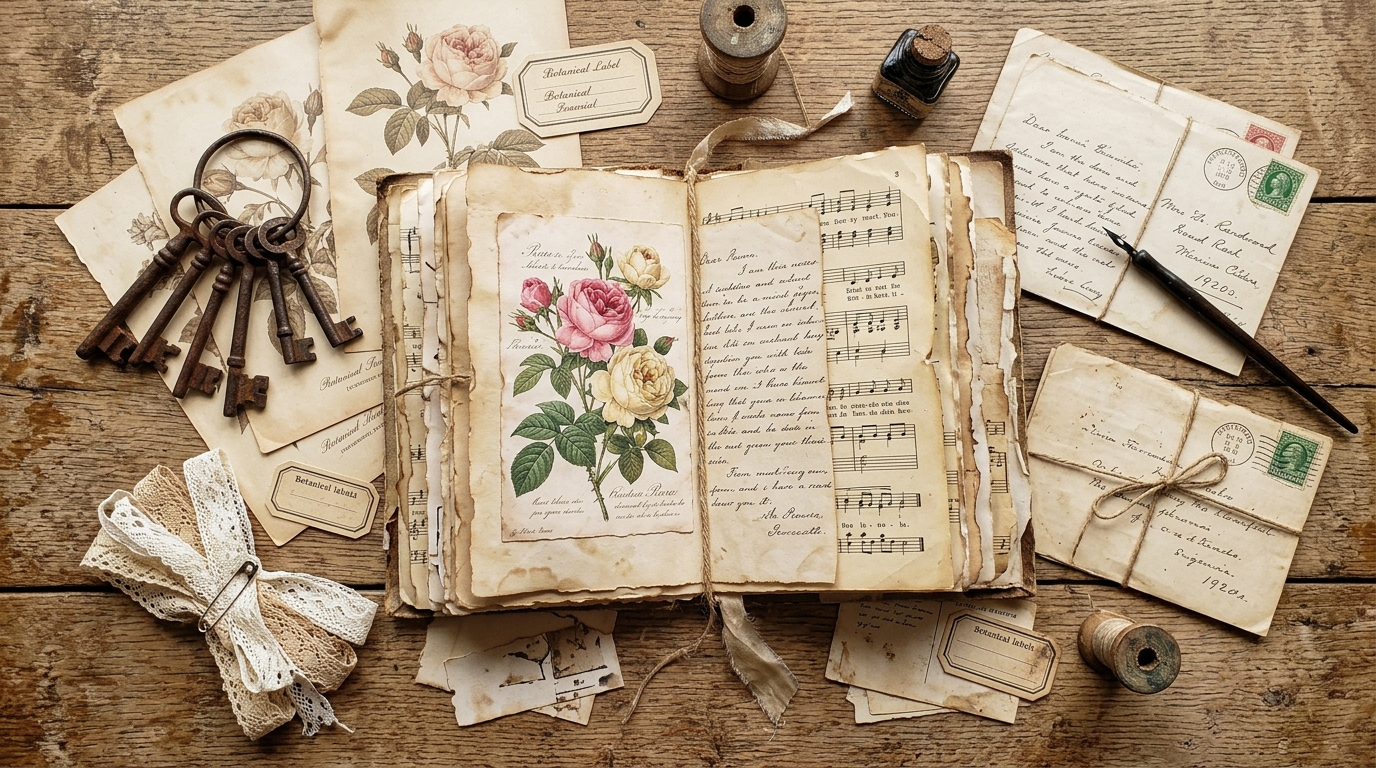
A postcard is not one document. It is five, layered on two sides of card.
Most people look at a vintage postcard the way they look at a photograph: the picture first, the message if it is legible, and then back into the box. But a postcard is a dense little archive. The image, the stamp, the postmark, the address and the message each carry independent evidence, and together they can place a card within a year, a town and a relationship. This guide shows how to read each layer — and where the evidence can mislead.
## Layer 1 — The image
Start with what the picture shows, but look at the details rather than the subject: shop signs, street lighting, vehicles, tram lines, clothing, advertising. These date the photograph or illustration more precisely than the caption. The publisher's name, series number or imprint — often printed vertically along an edge — identifies the producer and sometimes the era. Real photo postcards (photographs printed on postcard stock) are especially valuable as local records.
## Layer 2 — The stamp
The stamp gives you a country and a broad period. The design, denomination, portrait or motif changes over time, and specialists can date many stamps closely. Even without specialist knowledge, a stamp tells you whether the card travelled domestically or abroad, and whether the postal rate matches the card's claimed era. A stamp can also be a later addition — collectors sometimes replaced damaged stamps — so treat it as evidence, not proof.
## Layer 3 — The postmark
The postmark is usually the strongest dating clue: it can include a date, a town, a sorting office and sometimes a slogan or event cancellation. Read it carefully — postmarks are often partial, smudged or struck across the stamp and card. A clear date is gold; a partial one still narrows the period. Remember that the postmark dates the *sending*, not the printing. Cards could sit in a shop for years before being used.
## Layer 4 — The address and handwriting
Addresses record street names, house numbers and titles that may have vanished. Handwriting style, ink colour and pen type can support a date, though they are weaker evidence than a postmark. Look for titles ("Mrs", "Miss", professional titles), abbreviations and postal instructions. On early cards, the address may occupy the whole back; later cards divide the back between message and address.
## Layer 5 — The message
The message is where the card becomes human: weather, health, arrivals, thanks, gossip, jokes. It also reveals conventions — how people opened and closed, what they considered worth saying, what they left out. A message can confirm the relationship between sender and recipient, and occasionally dates the card indirectly ("we arrive on Tuesday").
> **A worked reading:** Imagine a card showing a market square. The stamp is a mid-century design; the postmark reads a partial date and a town 40 miles away; the message says "arrived safely, the shop is still there"; the address uses a street that was renamed later. Each layer supports the others: the card was printed earlier, sent later, and records a place at a specific moment. That is the value — not one clue, but the agreement between them.
## Where readings go wrong
* **Printing date ≠ sending date:** cards lingered in stock;
* **Reproductions:** modern reprints of old images can look convincing;
* **Reused cards:** stamps and postmarks can be added or altered;
* **Undivided backs:** early format, but not a precise date on its own;
* **Local variations:** postal rules differed by country.
## What to record
For a collection, note five things on the sleeve or in a database: publisher, image subject, stamp, postmark (date and place), and message summary. That record turns a shoebox into an archive — and makes the card usable in research or in a journal with proper context. Our [history of the postcard](/blog/evolution-of-the-postcard/) explains the format's evolution; the [photo-dating guide](/blog/dating-old-photographs/) covers the image side in more depth.
Reading a postcard well is a small act of attention. The card was designed to be glanced at; you are choosing to read it slowly. That is exactly the relationship with paper this whole craft is about.
---
*Related: <a href="/blog/evolution-of-the-postcard/">the evolution of the postcard</a> · <a href="/blog/dating-old-photographs/">dating old photographs</a> · <a href="/blog/paper-time-capsule/">the paper time capsule</a>.*