Victorian Calling Cards and Trade Cards: A Collector's Introduction
By Ephemera Crafts Atelier
•
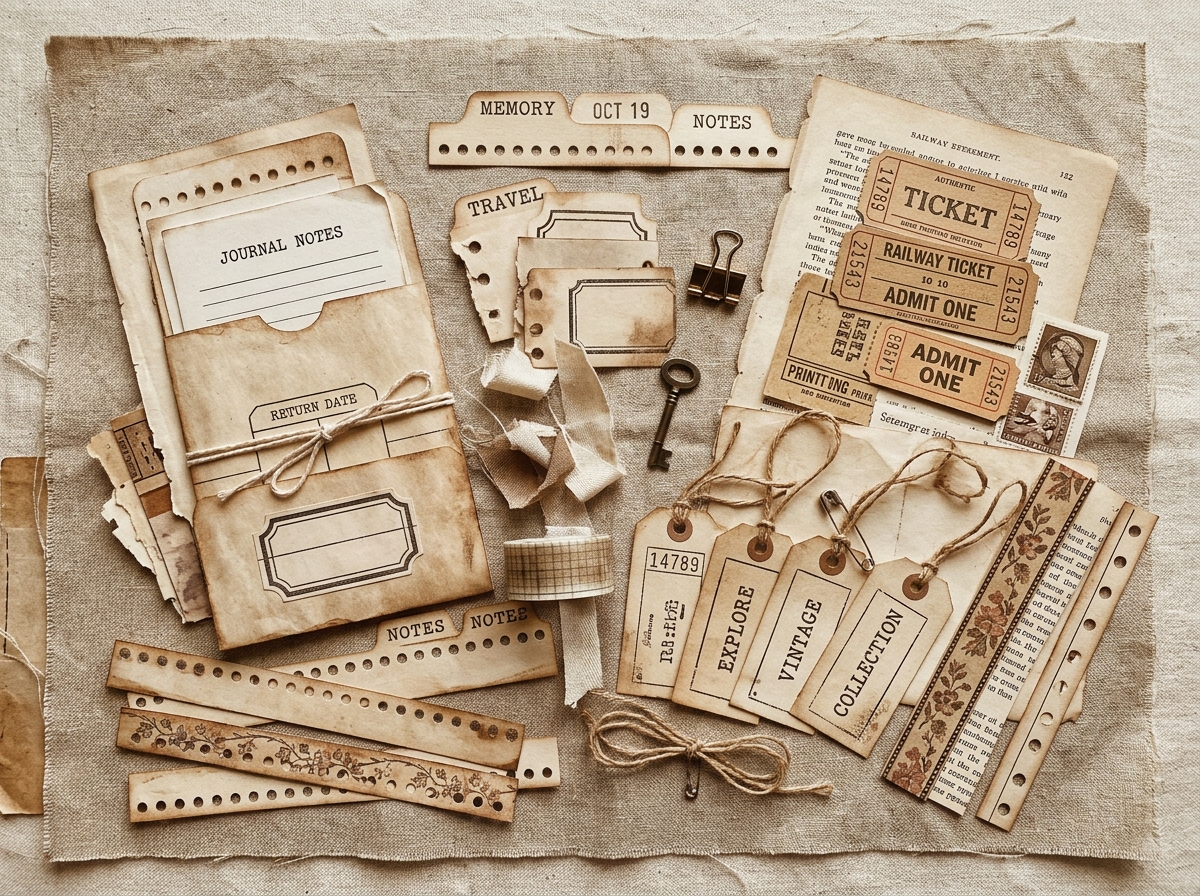
The social ritual behind the small card — and how to use its beauty in your journal. Small enough to fit in a pocket, ornate enough to stop a page dead: the everyday paper that became the ancestor of modern collecting.
Long before business cards became forgettable rectangles, a small piece of cardstock carried an entire social performance. In the 19th century, calling cards — also called visiting cards — announced who you were, which family you belonged to, and whether a visit had been paid or returned. A generation later, their commercial cousins, trade cards, put colour printing into ordinary shops and homes. Together they are among the most rewarding entry points into antique ephemera: affordable, beautiful, and perfectly sized for junk journals.
## What a calling card actually was
A calling card was a small card, roughly the size of a modern business card, engraved with a person's name and often nothing else. It belonged to a formal system of social visits: when you called on an acquaintance, you left a card with a servant or in a card tray if the person was not receiving; a returned visit was acknowledged with a card of one's own. Cards were kept in silver or porcelain receivers in the hall, and the etiquette of when to leave one, how many, and to whom filled whole chapters of conduct manuals.
You may have read that folding a corner carried secret meanings — sympathy, congratulations, farewell. The truth is more modest: some etiquette writers did describe a few conventional marks in certain contexts, but the elaborate "corner code" circulating online today is largely folklore. A folded corner is more likely to be a hundred years of handling than a hidden message.
## Why they look the way they do
Calling cards were personal luxury objects made with commercial printing technology: copperplate engraving for the name, embossed borders, blind stamping, gilt edges, die-cut scalloped shapes, monograms and small engraved vignettes. Because they were carried in pockets and card cases, many survivors show exactly the wear we try to imitate today — softened corners, faint foxing, a crease from the case. That authentic patina is why a single card can do more for a journal page than a whole sheet of modern "vintage-style" paper.
## From calling cards to trade cards
As colour lithography improved in the second half of the 19th century, businesses discovered that a beautiful card could travel further than any newspaper notice. Trade cards — advertising cards for shops, patent medicines, sewing machines, seeds and services — were handed out, collected, traded and pasted into scrapbooks. They were the first mass collectible: colourful, cheap, and designed to be kept. Victorian scrapbook culture grew alongside them, and the pasted page became a domestic art form.
This is where the lineage of today's junk journal becomes visible. The impulse to save a pretty card, arrange it beside a letter and keep the whole thing in a book is not a modern craft trend; it is a habit that industrial printing made possible and that people have never quite abandoned. If you want the longer view, our explainer on [What Ephemera Is](/blog/what-is-ephemera/) traces the word and the tradition.
## Why they suit junk journals so well
* **Format:** a calling card is almost exactly the size of a journal pocket or tag — no trimming required;
* **Weight:** thin cardstock layers without bulk, so several pieces can share a spread;
* **Detail:** engraving and embossing read as luxury even at a glance, giving a page an instant focal point;
* **Proportion:** the small scale makes surrounding layers feel generous;
* **Age:** foxing, softened edges and faded ink are features, not flaws — they cannot be reproduced convincingly by distressing alone.
## Ways to use them in a page
Treat a card as the "hero" of a composition and build around it: three to five overlapping pieces, one text fragment, one small accent, and the card holding the centre. Slip it into a [Tuck Spot](/blog/creative-ways-to-use-printable-ephemera/) so it can be removed and read; back a tag with it; use it as the cover of a mini pocket; or let it title a page — a calling card with a name becomes a natural heading for a spread about a person, a place or a season. For a softer look, layer a translucent vellum strip over one edge so the engraved border shows through.
> **Collector's rule:** Never glue an original card directly into a journal. Scan or photograph it first, print the reproduction for the page, and keep the original in an acid-free sleeve. You get the beauty twice — and lose nothing.
## Starting a small collection
Calling and trade cards remain one of the most accessible corners of antique paper: they turn up in antique shops, paper fairs, estate sales and mixed lots, often for modest prices because they were produced in enormous quantities. Collect by motif (botanical, architectural, animals, typography), by place name, or simply by "cards that make you stop". Check condition as you would for any paper: avoid heavy water damage or active mold, accept light foxing and edge wear as character.
Store them flat, out of direct sunlight, in acid-free sleeves or a shallow box. Handle by the edges; skin oils are slow damage. And photograph your favourites at high resolution — a good scan is both a backup and the raw material for your own printable reproductions.
## Bringing the tradition into your journal
You do not need an antique collection to borrow the look. Our [Vintage French Tags](/product/vintage-french-tags-ephemera/) and the [Antique Butterfly Collector Kit](/product/antique-butterfly-collector-folder-envelope-printable-kit/) are built from restored period paper in exactly this spirit — the detail of the original, sized for modern journal pages. Print a sheet, cut a card, tuck it into a pocket, and you are participating in a ritual older than the word "ephemera" itself: keeping the small paper things that would otherwise vanish.
---
*New to the tradition? Start with the [History of Ephemera](/blog/what-is-ephemera/), then browse [Ephemera Kits](/category/ephemera/) or the [Free Printables Vault](/free-printables/).*